Les Deutsch's Organ Software Development |
| If you are not a highly-technical person who likes to design software-based digital musical instruments, press your browser's "back" button now! |
| |
| News
I have updated my "Modified Litomysl Organ" for compatability with Jiri Zurek's new 24-bit wet sample set. My old organ files will not work with the new samples so be sure to download my new version if you purchase Jiri's upgrade.
I have just released v1.2 of "Jeux d'Orgues d'Trois Claviers". This is a three-manual version of the Jeux d'Orgues organ developed byJoseph Basquin and modified and expanded for Hauptwerk by Graham Goode. The update includes improved screen graphics (thank you Graham!) and a minor revoicing of the Swell division.
I am converting a very large old electronic theater organ console as a controller for Hauptwerk. Please watch my progress here.
Be sure to visit my a organ demonstration recordings page so you can hear music from these organs.
Jump directly to the organs - download and have fun!
Background
I created this web page to have a place to post my software development work for various digital organ projects as a service to others who could benefit from this work. I do not have a commercial venture in this area. In the old days (more than 20 years ago now) I was very active in commercial development of digital organs and synthesizers but today I am content to do this to further my own personal enjoyment and performance possibilities.
I use two software systems to create software-based organs for my own use.
Hauptwerk is a very fine commercial product developed by Martin Dyde in the UK. It has the best audio rendering engine of any of the products I have tested. In addition, it has become a de-facto standard for people who sample real pipe organs either for commercial or preservation purposes. Hence there are many good sample sets available - though some are pricey. None of them comes close in cost to purchasing a physical digital organ. I use Hauptwerk for all my sample work today. Hauptwerk runs on Windows and OS-X. As a very heavy Mac user, I really appreciate this!
jOrgan is an open source system developed by Sven Meier (and others) in Sweden. Being open source, it is totally free. It runs on Windows, OS-X, and Linux. jOrgan does not produce sounds. It is, however, a fantastic organ relay program with a great visual programming interface. It takes very little time to develop "consoles" and wire them to sound sources and keyboards. I use jOrgan as the front end to Hauptwerk. In this way, I combine the strengths of both programs to create a highly-optimized performance environment.
I will post new projects to this site as they become available. Please come back and check for updates and new organs.
Here is what is currently on this page:
Expanded Schantz Organ (Version 1.2)
Hauptwerk Composite 3-Manual English Organ (Version 2.1)
Wurlitzer "skin" for jOrgan
Hauptwerk Modified Litomysl Organ (Dry and 16-bit Wet versions, Version 2)
By the way, I also play piano (and other things) in the Night Blooming Jazzmen. I maintain the web site for the band - hence it is a convenient place for me to post things like this. Take a look at the band pages too!
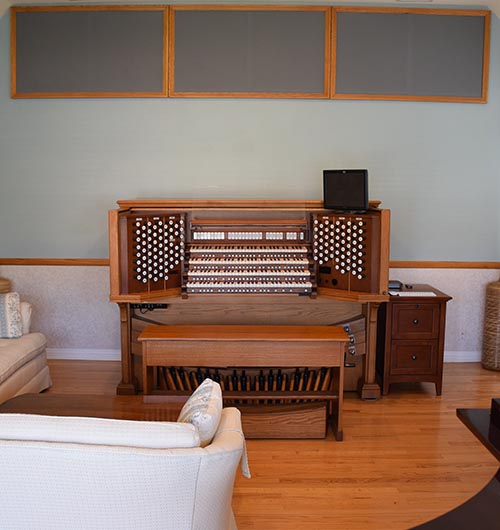
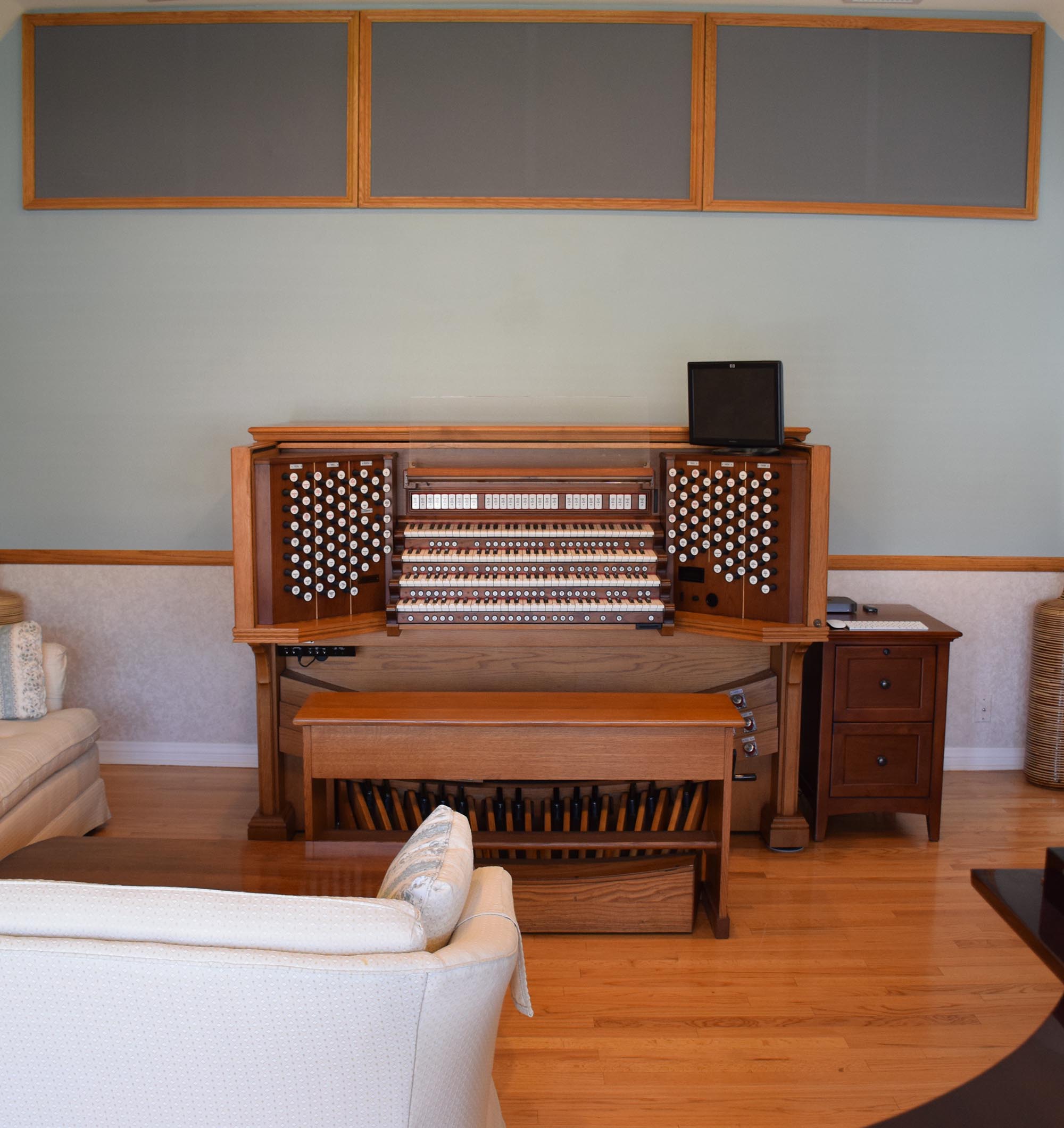
Here is a photo of my "performance" setup at home. Im addition, I have a development system in my studio that looks nowhere near as pretty.

|
| |
| Hauptwerk Composite 3-Manual English Organ (Version 2.1) |
| |
| I have a Rodgers 3-manual 945 organ. When I purchased Hauptwerk I noticed that there were no free sample sets for organs larger than 2 manuals. I therefore used the CODM to piece one together from three excellent sample sets that are nearly-free to licensed Hauptwerk users: the St. Annes Moseley organ that comes bundled with Hauptwerk, and the Little Waldingfield and Groton organs from Lavender Audio. The Lavender Audio organs are shareware so they are available at a very low cost. In addition you may use them for a limited trial period for free evaluation.
I used the St. Annes Mosley organ for the Pedals, Great, and Swell. I took some of the stops and moved them to a new choir manual. I then used the Lavender Audio samples to fill out the choir.
For version 2, I filled out a cornet in the Swell using some interesting methods. I reused the samples from the Swell 4’ and 2’ flutes to create the 2-2/3’ Nazard. The top seven notes come from the 2’ samples and the rest from the 4’. Since Hauptwerk allows one to create new ranks from reused samples, it is as if the builder had duplicated these pipes and placed them on their own chest. I have returned the resulting “rank” and also carefully balanced the transition between the two sets of samples. I similarly created the 1-3/5’ Tierce from the 2’ samples. The top few notes do not play (they wouldn't likely on a pipe organ anyway.)
For version 2.1, I fixed a bug that caused the "Bass Coupler" to function improperly. In the new version, engaging the coupler correctly plays the pedal stops from the lowest note only of whatever is played on the Great.
I also added some borrowed stops in the Pedal to give it more independence and reduce the need for coupling.
Since the two new ranks are true Hauptwerk ranks, there no is unification, the tuning is correct, and the user can voice each ranks separately (assuming you have the deluxe edition of Hauptwerk.)
The result is excellent and I often practice with these samples.
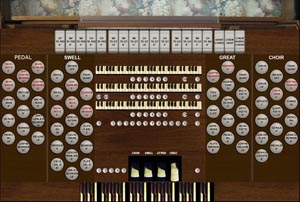
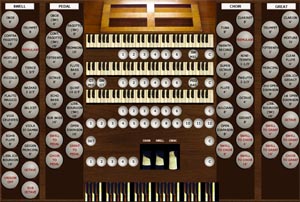
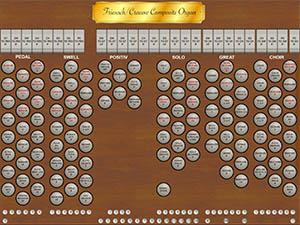
Here is a shot of the "console" and "stop" views. Click on them for full-size views. All my consoles are sized to fit on a 1024x768 touch screen monitor I keep atop my Rodgers. |
|
English Composite Organ: Specification |
|
Pedal |
|
Choir (Expressed) |
|
Great |
|
Swell (Expressed) |
16' |
Open Diapason |
8' |
Open Diapason |
16' |
Lieblich Bourdon (Sw) |
16' |
Lieblich Bourdon |
16' |
Sub Bass |
8' |
Gedekt |
8' |
1st Open Diapason |
8' |
Geigen Principal |
16' |
Bourdon (Sw) |
8' |
Dulciana |
8' |
2nd Open Diapason |
8' |
Rohr Flute |
16' |
Echo Bass |
4' |
Octave |
8' |
Lieblich Gedact |
8' |
Viol di Gamba |
10 2/3' |
Quint |
4' |
Flute |
4' |
Principal |
8' |
Voix Celestes |
8' |
Octave |
2 2/3' |
Twelfth |
4' |
Clear Flute |
4' |
Flauto Magico |
8' |
Flute Bass |
2' |
Super Octave |
2' |
Fifteenth |
4' |
Salicet |
4' |
Fifteenth |
1 1/3' |
Nineteenth |
|
Mixture IV |
2 2/3' |
Nazard |
16' |
Trombone |
1' |
Twenty-Second |
8' |
Trumpet |
2' |
Piccolo |
16' |
Contra Fagotto (Sw) |
8' |
Cornopean |
4' |
Clarion |
1 3/5' |
Tierce |
8' |
Fagotto (Sw) |
8' |
Clarinet |
4' |
Great to Great |
|
Mixture III |
4' |
Oboe (Sw) |
|
Tremulant |
16' |
Swell to Great |
16' |
Contra Fagotto |
8' |
Great to Pedal |
16' |
Swell to Choir |
8' |
Swell to Great |
8' |
Trumpet |
8' |
Swell to Pedal |
8' |
Swell to Choir |
4' |
Swell to Great |
8' |
Oboe |
8' |
Choir to Pedal |
4' |
Swell to Choir |
8' |
Choir to Great |
|
Tremulant |
|
|
|
|
|
|
16' |
Swell to Swell |
|
|
|
|
|
|
|
Swell Unison Off |
|
|
|
|
|
|
4' |
Swell to Swell |
|
| |
If you want to try this, be sure you first have a valid Hauptwerk license (this organ will not work without one, but it does not require a special dongle file) and both of the Lavender Audio organs installed correctly. Then download the following:
1. Download Hauptwerk Installation rar
This is a Hauptwerk standard installation package in rar format. Save it to your disk, start Hauptwerk, and then use its install feature to read the rar file as per the manual.
I have heard from some users (outside the USA) that you might need to disable the "wind model" for the organ to play properly. Since I am in the USA I cannot test this - but it sounds reasonable.
Some users have also reported problems upon loading the organ. They have gotten Hauptwerk error messages about missing files. If this happens, please decompress the rar file manually and move the folder "537000" inside Hauptwerk/HauptwerkSampleSetsAndComponents/OrganInstallationPackages. Then try loading it again. It should work now.
2. Download CODM Source File
This one is optional. I provide the source code for the Hauptwerk editor so you can see how I did all this and get ideas for your own projects.
This organ works so well because all three of the source organs are of similar style and were sampled in similar acoustics. |
| |
| Wurlitzer "skin" for jOrgan |
| |
| The second project is a new skin I developed for jOrgan. I had purchased Neil Jensen's excellent 3-11 starter theater organ and discovered that it required a large format monitor. Since I wanted to use my existing touchscreen monitor, I decided to create a jOrgan front end as mentioned above. Since theater organs have lots of stops, I needed a way to make the stop tablets small so they would all fit. I also wanted to be able to read them quickly while performing. I decided to borrow the solution used by WurlitZer (and other theater organ makers). My tabs have small labels for their names, but large labels for the footages and rank abbreviations. The later are at the front edge of the tabs. Click on the image for a full-size view - its the only way you'll see this! |
|
| |
| In order to do this, I had to use the "description" element filed and bind text to different layers. The easiest way to explain it is for you to examine to skin.xml file. You will also need two free fonts to use my skin. I chose these because they were free and approximated the fonts used by WurlitZer. Both fonts are available for Windows and OS-X at AbstractFonts.com. The two fonts you will need are MankSans and TypoSlabSerif-Light. Install these and then download and try the skin. You will get a zip file. Unzip the file and place it in your "skins" folder. |
| |
| Hauptwerk Modified Litomysl Organ (Dry, 16-bit Wet, and 24-bit Wet versions, Version 2) |
| |
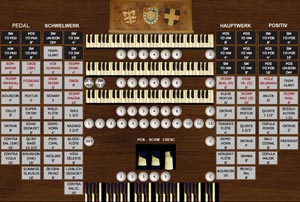
| The third project is a modified version of the popular Hauptwerk organ from the church in Litomysl, Czech Republic - a major Hauptwerk sampling project from Jiri Zurek. Because it provides a large four-manual neo-baroque concert organ at a moderate price, this sample set is one of the best-selling of all Hauptwerk organs.
I purchased the "dry" version of the Litomysl organ for my own use and I developed a jOrgan console for it as discussed in the theater organ project above. However, I wanted to make further modifications to the Litomysl design so I decided to create a completely new Hauptwerk organ using the samples provided with the Litomysl set.
The specifications of my 3-manual Litomysl organ (Version 2) are: |
| |
Les' Litomysl Organ V2 |
|
Pedal |
|
Positiv (Expressed) |
|
Hauptwerk |
|
Schwelwerk (Exp) |
16' |
Subbass Clausus |
8' |
Copula Major |
16' |
Bourdon |
16' |
Contra Salicional |
16' |
Contra Viola |
8' |
Salicional |
8' |
Principal |
8' |
Geigenprinzipal |
16' |
Bourdon (H) |
4' |
Prestant |
8' |
Konzertflöte |
8' |
Lieblich Gedackt |
16' |
Contra Salicional (S) |
4' |
Copula Minor |
8' |
Gamba |
8' |
Aeoline |
10 2/3' |
Quint Bass |
2' |
Oktave |
8' |
Gemshorn |
8' |
Voix Céleste |
8' |
Oktave |
1 1/3' |
Quinte |
4' |
Oktave |
4' |
Principal |
8' |
Rohrgedackt |
|
Sesquialtera I-III |
4' |
Travserflöte |
4' |
Gemshorn |
8' |
Cello |
|
Akuta IV |
2 2/3' |
Quinte |
4' |
Blockflöte |
4' |
Superoktav |
8' |
Tromp Real (unexp) |
2' |
Oktave |
2 2/3' |
Nazard |
4' |
Bourdon (H) |
8' |
Holz Krumhorn |
|
Gross Mixtur V |
2' |
Waldflöte |
|
Mixtur V |
|
Tremulant |
|
Klein Mixtur IV |
1 3/5' |
Terz |
32' |
Tromp Imperial |
16' |
Pos to Pos |
16' |
Tromp Magna (S) |
|
Scharf V |
16' |
Posaune |
|
Pos Unison Off |
8' |
Tromp Real (P) |
16' |
Tromp Magna |
8' |
Bombarde |
4' |
Pos to Pos |
8' |
Enge Trompette (S) |
8' |
Enge Trompete |
4' |
Oboe (S) |
16' |
Sw to Pos |
16' |
Sw to Hw |
8' |
Oboe |
8' |
Hw to Ped |
8' |
Sw to Pos |
8' |
Sw to Hw |
8' |
Vox Humana |
8' |
Sw to Ped |
4' |
Sw to Pos |
4' |
Sw to Hw |
4' |
Tromp Charamant |
4' |
Sw to Ped |
|
|
16' |
Pos to Hw |
|
Temulant |
8' |
Pos to Ped |
|
|
8' |
Pos to Hw |
16' |
Sw to Sw |
4' |
Pos to Ped |
|
|
4' |
Pos to Hw |
|
Sw Unison Off |
|
|
|
|
|
|
4' |
Sw to Sw |
|
| |
| I removed the Bombardewerk division, placed the 32' reed in the pedal, the 8' reed in the Positive (voiced as a chamade), and the 16' and 4' reeds in the Schwelwerk. I moved the 8' reed from the Hauptwerk to the Schwelwerk and revoiced all the Scwelwerk reeds to work as a convincing ensemble. I revoiced the Positiv Krummhorn to make it more of a solo voice that can be used to boost the ensemble.
I discarded the "Great Cornet" since I could not see any use for it. I also got rid of the key and stop noise samples to save memory and make the organ run more smoothly. This is, of course, a matter of taste. I am not trying to recreate the sound of the original organ but rather I am trying to create a good performance and recording instrument for my own use.
There were not enough reeds to give the Hauptwerk an independant chorus so I provided borrowing from the Positiv and Schelwerk to substitute here.
I "deepened" the Schwelwerk box to give it more expression. I also added a swell box for the Positiv. I left the Tromp Real out of the box as expected for a chamade rank.
I added a second borrowed stop from the Hw to the Pedal - the 16' Bourdon - to provide some variety.
Finally, I added a more complete compliment of couplers and general revoicing to bring everything in what, to me at least, seams like a proper balance.
New for version 2:
I have now added additional couplers so that the Positiv now couples at 16’ and 4’ pitch.
I added the 4’ Blockflote to the Schwelwerk in order to form a complete cornet in this division. The stop uses the samples of the 8’ Lieblich Gedakt for the first octave and the samples from the 2’ Waldflote for the remaining octaves. Despite the fact that this is a borrowed stop, the effect in the cornet is very satisfying and it fills in a serious gap in the original Litomysl specification.
I added the pedal 4’ Oboe. It is borrowed from the Schwelwerk.
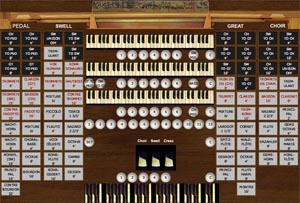
As usual, my screens all fit on a 15" 1024 x 768 pixel display. I had to create rectangular "stop buttons" to make the console view fit and still provide large enough stop controls for good real-time performance control on the touchscreen. Here are the "console" and "stop" views: |
| |
|
| |
| Thanks to Ed Martin who graciously allowed me to test my organ definition with the 16-bit Wet Litomysl organ samples, plus a very reasonalbe upgrade fee to get the 24-bit "version 2" samples, you can now use my organ definition with either the dry, 16-biut wet, or 24-bit wet versions. Be sure to download the correct version for your samples. You can run them all on your computer as long as you own all the sets of samples.
If you want to try this, be sure you first have a valid Hauptwerk license and the appropriate version(s) of the Litomysl Organ installed correctly. Then download the following:
1a. Download Hauptwerk Dry Installation rar
and/or
1b. Download Hauptwerk 16-bit Wet Installation rar
and/or
1c. Download Hauptwerk 24-bit Wet Installation rar
These are standard Hauptwerk installation packages in rar format. Save to your disk, start Hauptwerk, and then use Hauptwerk's install feature to read the rar file(s) as per the manual.
I have heard from some users (outside the USA) that you might need to disable the "wind model" for the organ to play properly. Since I am in the USA I cannot test this - but it sounds reasonable.
If you do not have touch sensitive keyboard, then you should also disable "key sensing" in both the general and organ settings in Hauptwerk. Failure to do so will result in a sluggish and unusable instrument.
Some users have also reported problems upon loading the organ. They have gotten Hauptwerk error messages about missing files. If this happens, please decompress the rar file manually and move the folder "537000" inside Hauptwerk/HauptwerkSampleSetsAndComponents/OrganInstallationPackages. Then try loading it again. It should work now.
2a. Download Dry CODM Source File
and/or
2b. Download 16-bit Wet CODM Source File
and/or
2c. Download 24-bit Wet CODM Source File
This step is optional. I provide the source code for the Hauptwerk editor so you can see how I did all this and get ideas for your own projects. |
| |
| Expanded Schantz Organ (Version 1.2) |
| |
| My latest organ is an expanded version of the popular Hauptwerk "FBR Schantz" organ created by Jonathan Orwig at Evensong Music.
The First Baptist Church of Riverside (FBR) Schantz Three Manual Organ has been a favorite Hauptwerk sample set for many years. With its recent price reduction, many more people will be discovering this organ. It is an “American Classic” style instrument with a small amount of reverberation (semi-dry acoustics).
My Expanded Schantz Organ recasts the sampled ranks from the FBR instrument into a larger specification that fills in some gaps in the original. There is, however, no unification in the resulting instrument. The new disposition is quite complete for a three-manual American Classic instrument. It retains a definite Schantz sound while not imitating any particular instrument.
New featrues are included for Version 1.2 of this organ. I have added a borrowed Basson 16' to the pedal to give the user a quieter choice of reed. By popular demand, I have added Swell and Choir Melody couplers. These allow stops from the Swell or Choir to be played together with the highest note played on the Great, providing some intersting possibilities. I also added a Bass coupler to the Great. For those of you who are not great pedalers (or who have to accomodate other organists with this deficiency), this takes the pedal stops and plays them from the lowest note on the Great.
The most complex new feature is full-blown crescendo pedal. Hauptwerk developers understand that the Custom Organ Definition Module (that I use to create my organs) does not currently have the ability to define a crescendo pedal. Luckily, Al Morse has developed software that adds crescendo pedals to already-existing Hauptwerk organs. My organ was too big for the software! The setter panel that it created went right off the bottom of the display. I worked with Al to understand more about his software and then wrote my own software to post-process the output of his. The result is a traditional (blind) crescendo pedal that is fully user-programmable on a nice display page.
The new "Expanded Schantz" organ has the following specification: |
| |
| Les' Expanded Schantz Organ |
|
Pedal |
|
Choir (Expressive) |
|
Great |
|
Swell (Expressive) |
| 32' |
Contre Bourdon |
8' |
Gemshorn |
16' |
Montre |
16' |
Rohrgedekt |
| 16' |
Principal |
8' |
Hohflöte |
8' |
Principal |
8' |
Geigen |
| 16' |
Bourdon |
8' |
Erzahler |
8' |
Flute Harmonique |
8' |
Rohrflute |
| 16' |
Rohrflute (Sw) |
8' |
Unda Maris |
8' |
Gedackt |
8' |
Gambe |
| 8' |
Octave |
4' |
Gems Octave |
4' |
Octave |
8' |
Voix Celeste |
| 8' |
Nachthorn |
4' |
Flute |
4' |
Sptizflöte |
4' |
Octave |
| 4' |
Choral Bass |
2 2/3' |
Nazard |
2' |
Waldflöte |
4' |
Flauto |
| 4' |
Nachthorn |
2' |
Principal |
1 1/3' |
Larigot |
2 2/3' |
Nazard |
|
Mixture III |
16' |
Basson |
|
Cornet V |
2' |
Piccolo |
| 32' |
Contre Fagotto |
8' |
Clarinet |
|
Mixture IV |
1 3/5' |
Tierce |
| 16' |
Fagotto |
8' |
Trumpet en Chamade |
16' |
Trombone |
|
Mixture IV |
| 16' |
Contre Trompette (Sw) |
|
Tremulant |
8' |
Trumpet |
16' |
Contre Trompette |
| 16' |
Basson (Ch) |
16' |
Choir to Choir |
4' |
Clarion |
8' |
Trompete |
| 8' |
Trompete |
|
Choir Unison Off |
8' |
Tromp en Cham (Ch) |
8' |
Hautbois |
| 4' |
Clarion (Gt) |
4' |
Choir to Choir |
4' |
Great to Great |
8' |
Vox Humana |
| 8' |
Great to Pedal |
16' |
Swell to Choir |
16' |
Swell to Great |
4' |
Rohr Schalmei |
| 4' |
Great to Pedal |
8' |
Swell to Choir |
8' |
Swell to Great |
|
Tremulant |
| 8' |
Swell to Pedal |
4' |
Swell to Choir |
4' |
Swell to Great |
16' |
Swell to Swell |
| 4' |
Swell to Pedal |
|
|
16' |
Choir to Great |
|
Swell Unison Off |
| 8' |
Choir to Pedal |
|
|
8' |
Choir to Great |
4' |
Swell to Swell |
| 4' |
Choir to Pedal |
|
|
4' |
Choir to Great |
|
|
|
|
|
|
|
Swell Melody |
|
|
|
|
|
|
|
Choir Melody |
|
|
|
|
|
|
|
Bass |
|
|
|
| |
Some borrowing of ranks between divisions was used and this is indicated on the stoplist. The Vox Humana was moved from the Choir to the Swell. The 2’ Principal was moved from the Swell to the Choir. Several stops were created by combining pipes from two of the original ranks, transposing as appropriate, and carefully working the transition notes in amplitude. These new stops are the Swell 8’ Geigen and 4’ Flauto, and the Choir Gems Octave. The Choir 8’ Hohlflote uses the samples from the Swell 8’ Rohrflote. In order to keep them from sounding identical, I brightened the Choir stop and made it a different volume level. Since there is no unification, one can couple these two stops together to create a flute ensemble. I also added the remainder of the standard American Classic couplers.
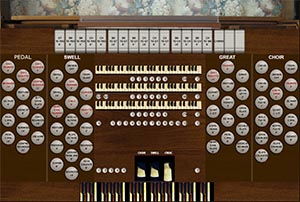
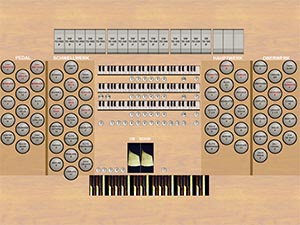
Since my own touch-screen monitor is only 15” (a size which fits nicely above a side-jamb of a typical organ) all my screens are sized to fit. The resolution is 1024 x 768. Here are the console and stop views: |
| |
|
| |
| Here is the crescendo setter page. Simply click on the lights to change them from red to green. Green indicates that corresponding stop will be "on" at the appropriate crescendo stage. |
| |
|
| |
| If you want to try this, be sure you first have a valid Hauptwerk license (this organ will not work without one, but it does not require a special dongle file) and have the FBR Schantz organ installed correctly. Then download the following:
1. Download Hauptwerk Installation rar
This is a Hauptwerk standard installation package in rar format. Save it to your disk, start Hauptwerk, and then use its install feature to read the rar file as per the manual.
I have heard from some users (outside the USA) that you might need to disable the "wind model" for the organ to play properly. Since I am in the USA I cannot test this - but it sounds reasonable.
2. Download CODM Source File
This one is optional. I provide the source code for the Hauptwerk editor so you can see how I did all this and get ideas for your own projects. Since the CODM cannot generate the crescendo pedal, I included version 1.1 of the organ here (identical except for the crescendo pedal). You can add a pedal back using Al's software, but you wilol not get the same display I have used in Version 1.2.
This organ is an exceptional value. You get ~60 ranks for $100 (I get nothing - but I have great a day job.) The organ is very complete and makes no compromises. It works well with many different genres of organ music. The samples are "only" 16-bit so the entire organ fits easily into a 3 GB system. It runs very well on my MacBook Pro laptop woth no measurable latency whatsoever. Remember that Hauptwerk's internal arithmetic is much deeper than 16 bits so the ensembles are accurate to many more significant bits. These samples were recorded in a live acoustic, but the hall is very dry. I add some simple delay reverb to the organ - using my Rodger's own internal reverb. The total effect is wonderful.
You can hear some demo recordings of this instrument on my organ recordings page. I have chosen pieces that show off the many variations in tone color that this organ can produce.
Have fun with this. |
| |
| Jeux d'Orgues d'Trois Claviers (Version 1.0) |
| |
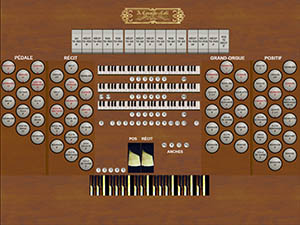
When Graham Goode released the Hauptwerk 3 version of Joseph Basquin’s “Jeux d’Orgues” Stiehr-Mockers organ, the organ community had an excellent free (assuming one already owns Hauptwerk, of course) 19th century organ. The only problem is that it is a two-manual organ. Not to say there is anything wrong with two-manual instruments – but my home console has three and I don’t like to see keyboards going to waste! You can find and download the Jeux d’Orgues” Stiehr-Mockers organ at http://www.jeuxdorgues.com/en/home.php You will need to do this before load my instrument. I embarked on this project to create a three-manual version of the Stiehr-Mockers organ. As in all of my organ design projects, I am not trying to recreate any specific instrument. Instead, I am creating satisfying instruments of important styles that I can use for my own enjoyment. This organ is created using Hauptwerk’s CODM and I make the source code available to others so they can see what I have done and maybe improve upon it. I call this organ “Jeux d’Orgues d’Trois Claviers” which is French (I believe) for “Organ stops on three manuals” or something close!
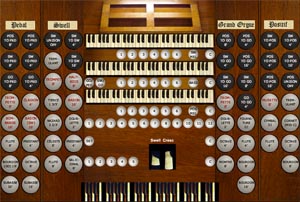
Version 1.2 sports a new set of screen backgrounds designed by Graham Goode. In addition, he embarrassed me into renaming the old “Great” division to “Grand Orgue” which makes a lot more sense for this decidedly French instrument. Finally, I have replaced the utilitarian stop buttons with smaller versions of drawknob controls in the Console view.
The specification is as follows: |
| |
| Les' Jeux d'Orgues d'Trois Claviers |
|
Pedal |
|
Positif |
|
Great |
|
Swell (Expressive) |
| 32' |
Subasse |
8' |
Bourdon |
16' |
Bourdon |
8' |
Bourdon |
| 16' |
Subasse |
4' |
Flute |
8' |
Montre |
8' |
Salicional |
| 16' |
Bourdon (Gt) |
2' |
Octave |
8' |
Bourdon |
8' |
Celeste |
| 8'' |
Octave |
|
Cymbal III |
4 |
Octave |
4' |
Prestant |
| 8' |
Flute |
|
Cornet (Middle C) |
4' |
Flute |
2 2/3' |
Nazard |
| 4' |
Prestant |
8' |
Musette |
2' |
Doublette |
2' |
Doublette |
| 16' |
Bombarde |
|
Tremulant |
|
Fourniture III |
1 3/5' |
Tierce |
| 16' |
Bason (Sw) |
16' |
Pos to Pos |
8' |
Trompette |
16' |
Bason |
| 8' |
Trompette |
|
Positif Unison Off |
4' |
Great to Great |
8' |
Trompet |
| 4' |
Clairon |
4' |
Pos to Pos |
16' |
Swell to Great |
8' |
Hautbois |
| 8' |
Great to Pedal |
16' |
Swell to Positif |
8' |
Swell to Great |
|
Tremulant |
| 4' |
Great to Pedal)] |
8' |
Swell to Positif |
4' |
Swell to Great |
16' |
Swell to Swell |
| 8' |
Swell to Pedal |
4' |
Swell to Positif |
16' |
Positif to Great |
|
Swell Unison Off |
| 4' |
Swell to Pedal |
|
|
8' |
Positif to Great |
4' |
Swell to Swell |
| 8' |
Choir to Pedal |
|
|
4' |
Positif to Great |
|
|
| 4' |
Choir to Pedal |
|
|
|
Swell Melody |
|
|
| |
|
|
|
|
Positif Melody |
|
|
|
| |
I used most of the Great from the Stiehr-Mockers organ intact. Only the Salicional and Cornet were removed so they could be used on the other manuals. The Positif uses Stiehr-Mockers Swell Bourdon as its foundation. The 4’ Flute is a quieter version of the Great 4’ Flute. The 2’ Octave uses the top four octaves of the Stiehr-Mockers Great 4’ Prestant, voiced a bit brighter. The low octave comes from the Stiehr-Mockers Great 2’ Doublette, voiced to match the rest of the rank. The Cymbal and Cornet are unchanged. The Musette uses the samples from the Stiehr-Mockers Great Trompette, greatly brightened and softened. The Swell 8’ Flute is a brightened, softer version of the Stiehr-Mockers Great 8’ Flute. The Salicional is original, but I softened it a bit to blend with this division. I used its samples a second time (still softer) to create the Celeste. The upperwork is all from the Stiehr-Mockers unchanged – although I softened the Tierce a bit for my own taste. The Bason uses the Stiehr-Mockers Hautbois samples for the top four octaves and the Pedal 16’ Bombarde for the low octave. I brightened the Bombarde and matched the volume of the two ranks. The Pedal is exactly from the Stiehr-Mockers with two added borrowed stops to add to the flexibility of the instrument. I also added a comprehensive set of couplers – because its easy to do this in the CODM and you can never tell when you'll need them! Finally, I added a combination action to match my Rodgers console. Since my own touch-screen monitor is only 15” (a size which fits nicely above a side-jamb of a typical organ) all my screens are sized to fit. The resolution is 1024 x 768.
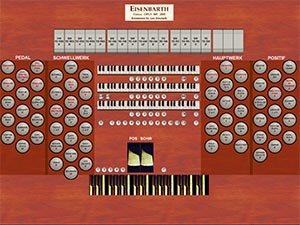
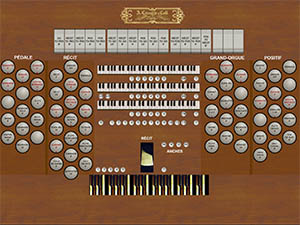
Version 1.2 sports a new set of screen backgrounds designed by Graham Goode. In addition, he embarrassed me into renaming the old “Great” division to “Grand Orgue” which makes a lot more sense for this decidedly French instrument. I have revoiced the swell to increase the volume of the main chorus flues. Finally, I have replaced the utilitarian stop buttons with smaller versions of drawknob controls in the Console view. Here are the console and stop views: |
| |
|
| |
If you want to try this organ, be sure you have Hauptwerk v3.20 or higher (this organ will work with the Free Edition and does not require a special dongle file) and have the Jeux d'Orgues organ installed correctly.You must adhere to the Jeux d'Orgues lisence as follows:
"The personal use of these soundbanks is free. However, you must contact Joseph Basquin for public or commercial usage, or if you want to publish Jeux d’orgues, or a modified version of Jeux d’orgues, on CDs, Internet, or by any other method. This soundbank still is and will remain free, but don’t forget that most similar soundbanks are not free, but rather expensive (usually more than 200$ for Hauptwerk/MyOrgan historical organs). This project will only be able to continue with your donations. Don’t forget to donat and help this project grow!"
Then download the following:
1. Download Hauptwerk Installation rar
This is a Hauptwerk standard installation package in rar format. Save it to your disk, start Hauptwerk, and then use its install feature to read the rar file as per the manual.
I have heard from some users (outside the USA) that you might need to disable the "wind model" for the organ to play properly. Since I am in the USA I cannot test this - but it sounds reasonable.
2. Download CODM Source File
This one is optional. I provide the source code for the Hauptwerk editor so you can see how I did all this and get ideas for your own projects.
This organ is a real value. You get ~40 ranks for fee (I get nothing - but I have great a day job. You might also consider contributing to the Jeux d'Orgues project on their web site) This organ is a small three manual instrument - but the divisions are complete enough for most organ repertoire. The complete set of couplers and combination action certainly helps! Since the samples are 16-bit, the instrument fits into RAM on all but the very smallest computers. The reverb on the samples is more than adequate for practicing. I add a additional convolution al reverb on my recordings - but this is a matter of taste. This makes a great low-cost alternative to my Composite 3 Manual English Organ for people starting out with Hauptwerk or on a limited budget.
You can hear some demo recordings of this instrument on my organ recordings page.
Have fun with this. |
| |